Hormones & Intimacy
He's Not a Mind Reader (and Neither Are You): How to Talk to Your Partner About Menopause
What to tell your partner, how to start the conversation, and how to bring up the harder stuff, including sex.

It often starts with something small, like the thermostat. Not a little disagreement. A real fight.
You've turned the air down to 64 for the third night in a row. Your partner is lying there in a sweatshirt. You're lying there feeling like you've been microwaved. Somewhere in the middle of it, they say, "I don't know what's going on with you lately."
And they really don't. You've been going through one of the biggest changes your body has ever been through, and you may not have told them a thing. You've been short with them, pulling away in bed, tired all the time, and just expecting them to get it.
He's not a mind reader. Neither am I. And once we actually talked about it, a lot got easier.
So here's what helps before the next thermostat fight: why this conversation matters, what to say, and how to bring up the harder stuff, including sex.
Why this conversation matters
Menopause doesn't just happen to us. It happens in our homes, our bedrooms and our relationships. The research backs this up:
- In the MATE survey, researchers asked 450 American men about their partners' menopause. About 63% said her symptoms affected them, and more than half of those said the relationship had suffered. Sex was the area men most often said had taken a hit.
- Yet the same men often didn't connect the dots. Many didn't realize the changes they were seeing were from menopause, and fewer than half knew there were treatments that could help.
- In the large CLOSER survey of 4,100 postmenopausal women and 4,100 male partners, more than a quarter of women didn't tell their partner when vaginal discomfort first started. Most thought it was just a natural part of getting older, and some were too embarrassed.
Here's the hopeful part: when couples understand what's going on, things improve. In the CLOSER survey, many women and men said treatment made sex less painful and more satisfying, and about a third said they felt emotionally closer afterward.
One myth to drop while we're here: you may have seen the claim that menopause causes most divorces. That figure doesn't hold up. It reflects the age when many women file for divorce, not the reason. Menopause can strain a relationship, but it doesn't have to break one.
What to tell them: the plain-English version
Your partner doesn't need a lecture on hormones. They need the basics, explained so it clicks. Here's one way to explain it:
"My estrogen has dropped a lot, and estrogen affects almost everything." Then the specifics that applied to me:
- Temperature: hot flashes and night sweats can come out of nowhere. It's not about the room being warm.
- Sleep: I'm waking up at 3 a.m. and can't fall back asleep, so I'm running on empty.
- Mood: I might be more irritable or anxious. It's not about you, and it's not me being dramatic.
- Memory and focus: brain fog is real. If I forget something, it's not because I don't care.
- Body changes: weight shifting to the middle, joint aches, dry skin.
- Sex: my body doesn't respond the way it used to. Dryness can make sex uncomfortable or painful, and my desire may be lower. This isn't about how I feel about you.
That last line matters most. When a woman pulls away physically, a lot of partners quietly assume it's personal: "She's not attracted to me anymore." Saying out loud that it's not about them can take a huge weight off.
Tip: send them an article. Some partners take in information better when it isn't coming at them in the middle of an emotional moment. (You're welcome to send them this one.)
How to start the conversation
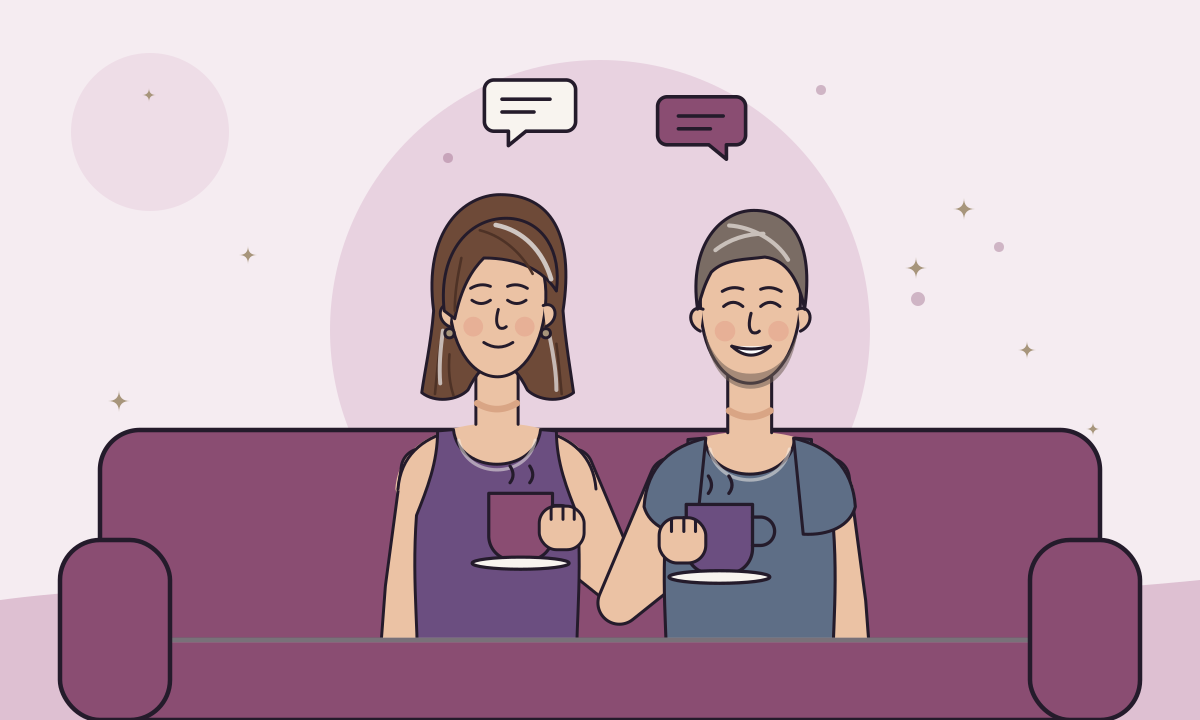
Pick a calm moment. Not in the middle of an argument, not at 11 p.m. when you're both exhausted, and not right after a hot flash has you ready to rip the covers off. A walk, a drive or a quiet coffee works well. Side by side is often easier than face to face.
Lead with "I," not "you." "I've been feeling off and I want you to understand why" lands very differently than "You never notice what I'm going through."
Keep the first talk short. You don't have to cover everything at once. Think of it as the first of many conversations.
Openers you can borrow
Then ask a question back. "What have you noticed?" or "How has this been for you?" Your partner may have been confused, hurt or worried and not known how to bring it up either.
The intimacy conversation
This is the one most of us avoid, and it's the one that matters most.
In the North American CLOSER survey, about 30% of women and men said vaginal discomfort was the reason they'd stopped having sex altogether. Many of those couples probably never talked about why.
Here's what helped us:
Name the physical part. "Sex has started to hurt because of dryness. It's a really common menopause thing, and it's treatable. I'm going to talk to my doctor about it." (Our article Vaginal Dryness: The Symptom Nobody Mentions covers the options, from moisturizers and lubricants to low-dose vaginal estrogen.)
Separate desire from love. "My sex drive is lower right now, but I still want to be close to you." This one sentence can prevent a lot of hurt feelings.
Widen the definition of intimacy. Cuddling, kissing, massage and touch that doesn't have to lead anywhere all count. Taking the pressure off often brings desire back.
Slow down and plan a little. Many women find that after menopause, desire shows up after things get started rather than before. More time, more warm-up and plenty of lubricant can change everything.
Remember they may have their own changes too. Many men in their 50s and 60s are dealing with less reliable erections, and some pull away out of embarrassment rather than lack of interest. Making it safe for both of you to talk helps.
If desire is the bigger issue, read our article Low Libido After Menopause? It's Not All in Your Head.
Ask for specific help
"Be more supportive" is hard to act on. Specific asks are easy. Here are some that worked in my house:
- "Can we get a fan for my side of the bed?" (Or separate blankets. Game changer.)
- "If I snap at you, can you give me 10 minutes before we talk?"
- "Can you take over dinner on the nights I don't sleep?"
- "Will you come with me to my doctor's appointment?" A second set of ears helps, and it shows you're in this together.
- "Can you not joke about my hot flashes in front of other people?"
- "Can we go on walks together after dinner?" Good for your body, your sleep and your connection.
What partners can do (send this part to them)
- Learn the basics. Read an article or two, or ask her what's been hardest.
- Don't take irritability or a lower sex drive personally. Ask what would help instead.
- Notice and say something kind. Many women feel less confident in their changing bodies.
- Support her decisions about treatment, including hormone therapy, without pushing her one way or the other.
- Be patient. Many symptoms get better with time and treatment.
When it doesn't go well
Not every partner gets it on the first try. Some get defensive. Some make jokes because they're uncomfortable. Some just don't know what to say.
Give it another shot. A first conversation that goes sideways isn't a final answer. Try again at a calmer time, or share an article and let them come back to you.
Bring them to an appointment. Hearing it from a doctor can make it feel more real and less personal.
Consider a counselor. A couples therapist or a certified sex therapist can help you talk about the hard stuff without it turning into a fight. Asking for help is a sign you care about the relationship, not that it's failing.
Take care of yourself either way. Your symptoms deserve treatment whether or not your partner fully understands them. Don't wait on anyone else's approval to feel better.
If you ever feel unsafe, or your partner is controlling, threatening or cruel, that's not a menopause problem. Reach out to someone you trust or the National Domestic Violence Hotline at 1-800-799-7233.
The bottom line
Your partner can't help with what they don't understand. A little honesty, a few specific asks and a willingness to talk about the awkward stuff can turn menopause from something that pulls you apart into something you face together.
Sometimes the fixes are small: a fan, separate blankets, and a lot more patience with each other. Once your partner understands what's happening, they can become your biggest ally.
Keep reading:
- Vaginal Dryness: The Symptom Nobody Mentions
- Low Libido After Menopause? It's Not All in Your Head
- HRT Revisited
Not sure where to start? Take our quiz, What's Your Menopause Season?, and share your results with your partner. It's an easy way to open the conversation.
Sources
- Parish SJ, Faubion SS, Weinberg M, Bernick B, Mirkin S. The MATE survey: men's perceptions and attitudes towards menopause and their role in partners' menopausal transition. Menopause. 2019. PMC6791510
- Nappi RE, Kingsberg S, Maamari R, Simon J. The CLOSER survey: implications of vaginal discomfort in postmenopausal women and in male partners. Journal of Sexual Medicine. 2013. PubMed 23809691
- CLOSER survey: emotional and physical impact of vaginal discomfort on North American postmenopausal women and their partners. Menopause. 2014. doi:10.1097/GME.0b013e318295236f
- The CLOSER survey: impact of postmenopausal vaginal discomfort on women and male partners in the UK. Menopause International. 2013. Link
This article is for general information and isn't medical or relationship advice. Talk with your doctor about your symptoms, and consider a licensed counselor or therapist for relationship concerns.